
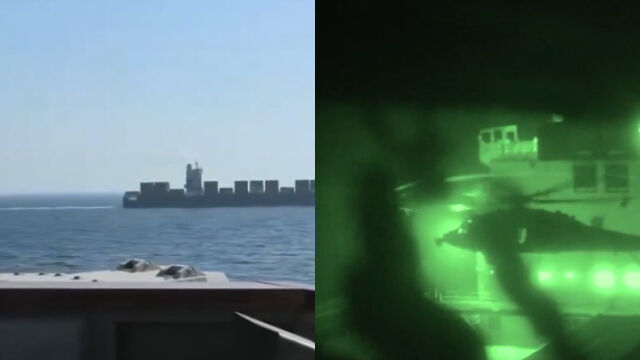
Video Captures US Boarding Iranian Ship – The Mystery Cargo Raises Serious Questions
U.S. forces just boarded and seized an Iranian-flagged container ship that tried to blow through the American blockade in the Strait of Hormuz — and the cargo on board is raising major red flags.
The ship, identified as the MV Touska, refused repeated warnings from U.S. Navy forces for roughly six hours. The guided-missile destroyer USS Spruance eventually fired on the vessel to disable its propulsion system after it ignored orders to stop. U.S. Marines then fast-roped from helicopters off the amphibious assault ship USS Tripoli and took control of the ship.
Watch the dramatic boarding footage released by CENTCOM:
U.S. Marines depart amphibious assault ship USS Tripoli (LHA 7) by helicopter and transit over the Arabian Sea to board and seize M/V Touska. The Marines rappelled onto the Iranian-flagged vessel, April 19, after guided-missile destroyer USS Spruance (DDG 111) disabled Touska’s… pic.twitter.com/mFxI5RzYCS
— U.S. Central Command (@CENTCOM) April 20, 2026
Watch additional video of the initial encounter:
WATCH : U.S. Central Command (CENTCOM) has released footage showing the interception of the motor vessel Touska in the Northern Arabian Sea by USS Spruance (DDG-111).
According to CENTCOM, the destroyer issued repeated warnings over several hours before taking action after… pic.twitter.com/AmaiZeXAHs
— Inside the conflict (@InsidConflict) April 19, 2026
The Touska was sailing under the Iranian flag and is operated by the Islamic Republic of Iran Shipping Lines (IRISL) — a state-owned company already under heavy U.S., British, and EU sanctions for its role in Iran’s ballistic missile and weapons proliferation programs.
What makes this incident especially suspicious is the ship’s recent route. While it was listed as departing from Port Klang, Malaysia, AIS tracking data shows it had just come from **Gaolan port in Zhuhai, China** — a known chemical-storage hub. Experts have previously flagged that port as a loading point for chemicals like sodium perchlorate, a key precursor for solid rocket fuel that Iran desperately needs for its missile program.
The ship has a documented history of procurement activities tied to Tehran’s missile efforts. No wonder it was willing to risk a direct confrontation with the U.S. Navy rather than comply.
The Iranian Revolutionary Guard Corps (IRGC) immediately went into full propaganda mode. State-linked outlets claimed the IRGC “intervened and forced the U.S. to withdraw” and even alleged drone attacks on American ships. The only problem? The U.S. Navy seized the ship and is now in full control of it. There is zero evidence of any successful Iranian counterattack.
This entire episode exposes Iran’s weakness and desperation. The regime can’t even get a single cargo ship through the strait without getting boarded, yet its propaganda machine still tries to spin it as a victory.
The real question now is what exactly was in those containers that made the Iranians willing to risk escalation. If it turns out to be missile-related materials from China, it would confirm what many have suspected: Tehran is still aggressively pursuing its nuclear and ballistic missile ambitions even after the recent pressure campaign.
President Trump’s maximum-pressure strategy is clearly working. The mullahs are testing the blockade and getting burned every time.
America controls the strait. Iran controls nothing but its own collapsing narrative.
—

Natalie Dagenhardt is an American conservative writer who writes for Right Journalism! Natalie has described herself as a polemicist who likes to “stir up the pot,” and does not “pretend to be impartial or balanced, as broadcasters do,” drawing criticism from the left, and sometimes from the right. As a passionate journalist, she works relentlessly to uncover the corruption happening in Washington. She is a “constitutional conservative”.


