
Statistically Impossible: Analysis of Nithya Raman’s Post-Election Day Ballot Drops Reveals Something That Has Never Happened in U.S. Election History
Nithya Raman went from third place on election night to leading the pack — and she did it by winning every single post-Election Day ballot drop* by huge margins.
That’s not just unusual. According to multiple analysts and election observers, it’s statistically impossible under any normal model of random voting.
On election night, Raman was clearly in third. Then, as the late mail-in and provisional ballots started coming in, she began gaining ground in every single batch. Not some batches. Not most batches. Every single one. The swings were large enough to erase Spencer Pratt’s lead and put her on top.
Screenshot:
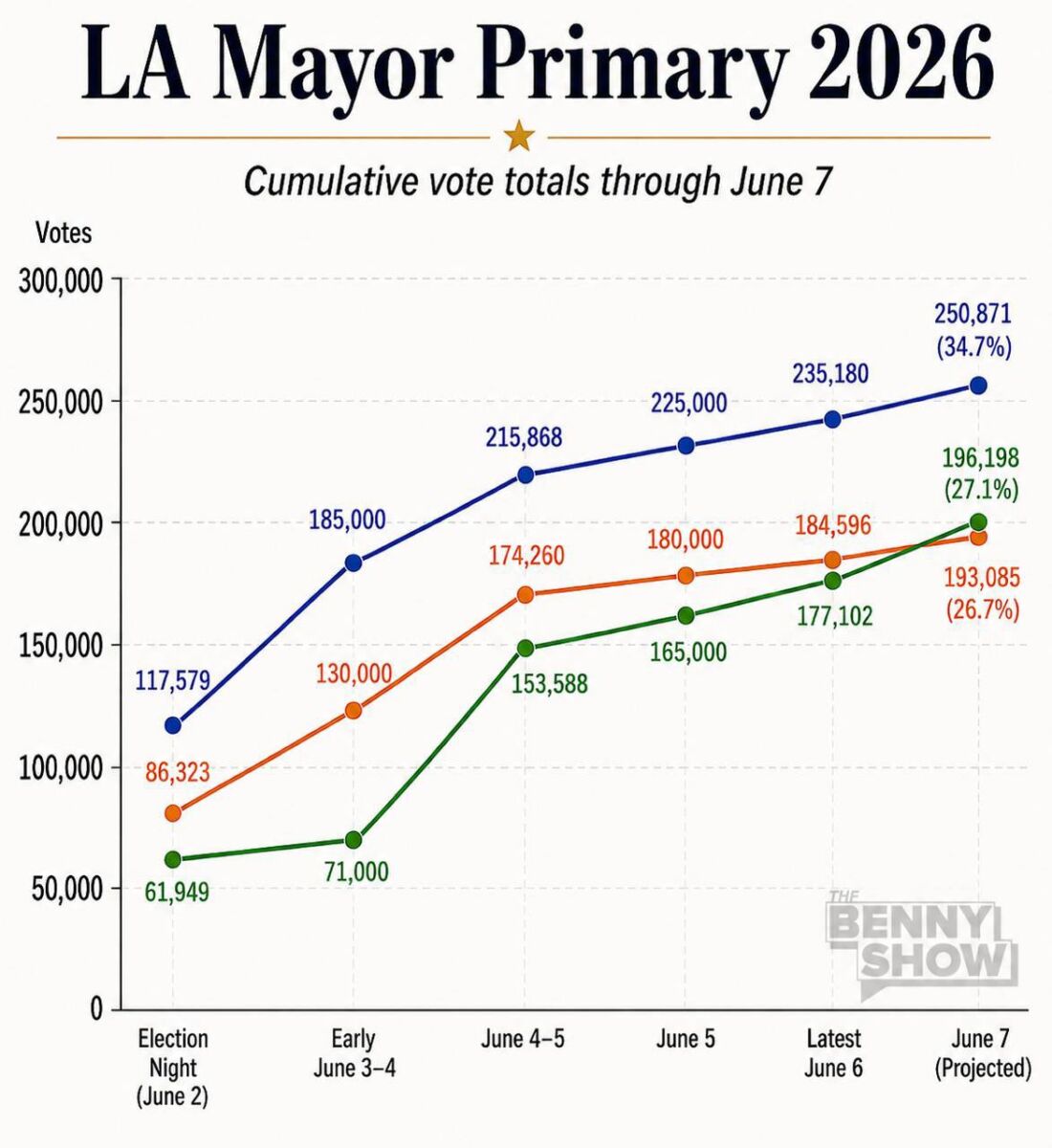
This kind of consistent, one-sided movement across multiple independent ballot drops has no precedent in modern U.S. election history. In a fair system, late ballots should roughly reflect the overall electorate or show normal statistical variation. Instead, Raman has dominated every drop in a way that defies probability.
Here’s why the numbers don’t add up:
Take the earlier example we’ve already seen in this race — one late-night drop of over 24,000 ballots where a candidate received exactly zero votes. If that candidate had roughly 30% support overall, the odds of getting zero votes in a random sample of 24,000 ballots is approximately **1 in 10^3,718**. That’s not just unlikely — it’s so improbable it’s effectively impossible under normal conditions.
Now multiply that kind of anomaly across multiple separate drops, all favoring the same candidate in the exact same direction, and the combined probability becomes even more absurd. This isn’t random variation. This is a pattern.
Other red flags in the same race include:
– Late ballots boosting only Raman while Karen Bass (another Democrat) saw almost no corresponding gain.
– The mayoral race somehow producing thousands more votes than the governor’s race.
– Raman herself appearing to concede on election night before suddenly surging days later.
When one candidate consistently wins every post-election ballot drop by large margins while others stay flat or lose ground, it breaks every rule of statistical probability and the law of averages.
This isn’t how elections are supposed to work. Late ballots should be representative, not a one-way rocket ship for a single candidate who was trailing on election night.
The people of Los Angeles deserve real answers and real transparency. When the math becomes this broken, the questions stop being optional.
—

Mark Van der Veen offers some of the most analytical and insightful writings on politics. He regularly opines on the motives and political calculations of politicians and candidates, and whether or not their strategy will work. Van der Veen offers a contrast to many on this list by sticking mainly to a fact-based style of writing that is generally combative with opposing ideologies.



This is heteroscedasticity. Your analysis is not considering the variance difference in voter turnout by type of voting. The breakdown of voters who voted on election day is not the same as those who voted by mail. The statistics is starting with an incorrect assumption.
You are correct, it doesn’t take into account ballot harvesting on skid row and in homeless shelters where for $2 you can buy a vote. Democrat SOP.
Wanker cunt maga retards lol
I don’t live in LA or CA, so I don’t care how long you want to keep the city and state drowning in Democrat waste of money. You get what you vote (wink-wink) for.
I wish Democrats could manage government as well as they STEAL ELECTIONS.