
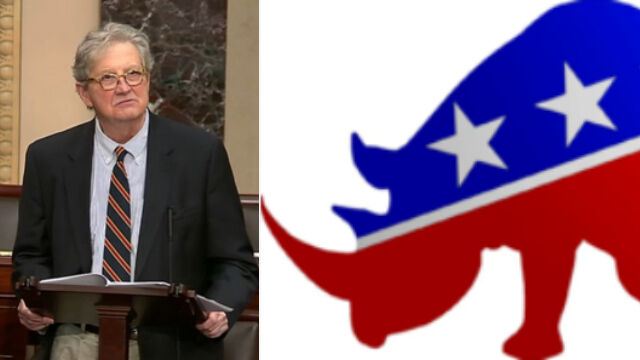
Four GOP Senators Doom Sen. John Kennedy’s SAVE America Act Fix — The Usual Suspects Strike Again
A key effort to advance election integrity legislation in the U.S. Senate just hit a major roadblock — and this time, it didn’t just come from across the aisle.
Sen. John Kennedy attempted to push forward a version of the Safeguard American Voter Eligibility Act — commonly known as the SAVE Act — by introducing an amendment that would have directed the Senate Rules Committee to incorporate its core provisions into a broader budget reconciliation package.
The proposal ultimately failed, falling short in a 48–50 vote.
While all Democrats opposed the measure, what drew the most attention was opposition from four Republican senators:
* Susan Collins
* Lisa Murkowski
* Thom Tillis
* Mitch McConnell
Their votes effectively blocked the effort, despite Republicans holding control of both chambers of Congress and the White House.
Kennedy’s amendment aimed to move forward provisions requiring proof of U.S. citizenship to vote in federal elections, implementing voter ID requirements, and limiting early voting — all central elements of the SAVE Act, which has been a legislative priority for many conservatives.
Before the vote, Kennedy made clear what he was trying to accomplish, stating his amendment would simply instruct the committee to “come up with an elections bill,” leaving room for negotiation on specifics.
Still, the measure couldn’t overcome internal divisions.
The House had previously passed the SAVE Act earlier this year, but in the Senate, the legislation faces a familiar obstacle: the 60-vote threshold required to advance most bills. Without bipartisan support, even measures backed by a majority can stall indefinitely.
The outcome has reignited debate over Senate procedures, particularly the role of the filibuster, which some lawmakers argue has become more of a barrier than a safeguard in today’s political climate.
Outside Washington, the issue continues to generate strong reactions. Actor James Woods weighed in on the broader debate over voter ID requirements in a widely shared post:
Republicans lose, because they don’t want to win. Arguing with Democrats is like appeasing a drunk. No matter what you say or do, they always have an answer.
And when you finally put your foot down, they cover their ears and scream like a toddler. https://t.co/ONk4ikzOwS
— James Woods (@RealJamesWoods) April 22, 2026
Rick Scott also defended the push for stricter voting measures, outlining his position in a separate statement:
This is what an invasion looks like.
This was all by design.
This is why Democrats are fighting tooth and nail to keep ICE and CBP defunded.
THIS is why we need to stop making excuses, BLOW UP THE FILIBUSTER and pass the SAVE America Act NOW! https://t.co/lpA7voI9mA
— Rick Scott (@SenRickScott) April 23, 2026
For now, the SAVE Act remains stalled in the Senate, and the failed amendment highlights a recurring reality in Washington: even when one party holds power, internal disagreements can be just as decisive as opposition from the other side.
With elections approaching and legislative windows narrowing, the path forward for election-related reforms remains uncertain.
This isn’t some brand-new story. These same names keep popping up whenever there’s a chance to actually push through meaningful reform. Call them moderates, call them institutionalists — a growing number of voters are calling them something else entirely: roadblocks.
Because at some point, it stops being about “process” and starts looking like refusal.
Republican voters didn’t hand the party power just to watch it stall out from the inside. With Donald Trump back in the White House, expectations are sky-high that long-promised policies — especially on election integrity — finally get delivered.
Instead, what they’re seeing is the same pattern: a handful of Republicans breaking ranks at the exact moment their votes matter most.
—

Mark Van der Veen offers some of the most analytical and insightful writings on politics. He regularly opines on the motives and political calculations of politicians and candidates, and whether or not their strategy will work. Van der Veen offers a contrast to many on this list by sticking mainly to a fact-based style of writing that is generally combative with opposing ideologies.